Thinking Machines and Bridgewater tested an open-weight model against frontier LLMs
Thinking Machines Lab, founded by former OpenAI CTO Mira Murati, raised a $2 billion seed round in 2025 and is reportedly in talks to raise at a valuation of around $40 billion. This summer it published Learning to Replicate Expert Judgment in Financial Tasks with Bridgewater Associates’ AIA Labs, testing six filtering tasks from an investor’s daily routine, such as sorting news articles by relevance or judging whether a central bank document signals where rates are heading.
The researchers ran frontier models from OpenAI, Anthropic and Google on plain prompts, then on expert-written prompts and automated prompt optimization. Finally, they fine-tuned an open-weight model, Qwen3-235B, on examples labeled by Bridgewater’s investors and scored it on held-out data it had never seen.
Prompting took the frontier models only so far: they averaged roughly 50% accuracy on plain prompts, and expert-written prompts improved on that without reaching the researchers’ 80% bar for a tool investors would trust day to day. The trained model cleared it, averaging 84.7% against 78.2% for the best frontier model, with about 30% fewer mistakes at 13.8 times lower cost. The knowledge that separated right answers from wrong ones lived with Bridgewater’s investors rather than in the public text the frontier models learned from, so no prompt could supply it. For a hedge fund evaluating AI for its research desk, the useful question is what a model was trained on, not how cleverly it is prompted.
We built Increase Alpha based on a similar concept
The study measured document triage, not investment returns, and it did not concern SEC filings. Its conclusion is still the conviction Increase Alpha was built on 18 months before ChatGPT launched: a specialized model trained on the right narrow data beats a general model, however well the general model is prompted. Our data supports it, with forecasts timestamped in production since July 2021, 34% of our universe carrying a strong directional signal at any given time, and factor regressions for every company’s model published in the Agent Explorer for anyone to check.
Filing intelligence turns the 10-Ks, 10-Qs and other SEC filings every public company must publish into evidence an investor can act on. Each of the 2,456 U.S. companies we cover has its own independent model, which reads only that company’s filings, measures how its disclosure language has changed against its own history, and combines that with its market data to produce a directional forecast. Systematic teams take the output as a daily signal file, while fundamental teams get a News Gap Report that traces each material change to its filing section and checks whether the press release, earnings call, financial news and analyst coverage picked it up, which is how we find the News Gap.
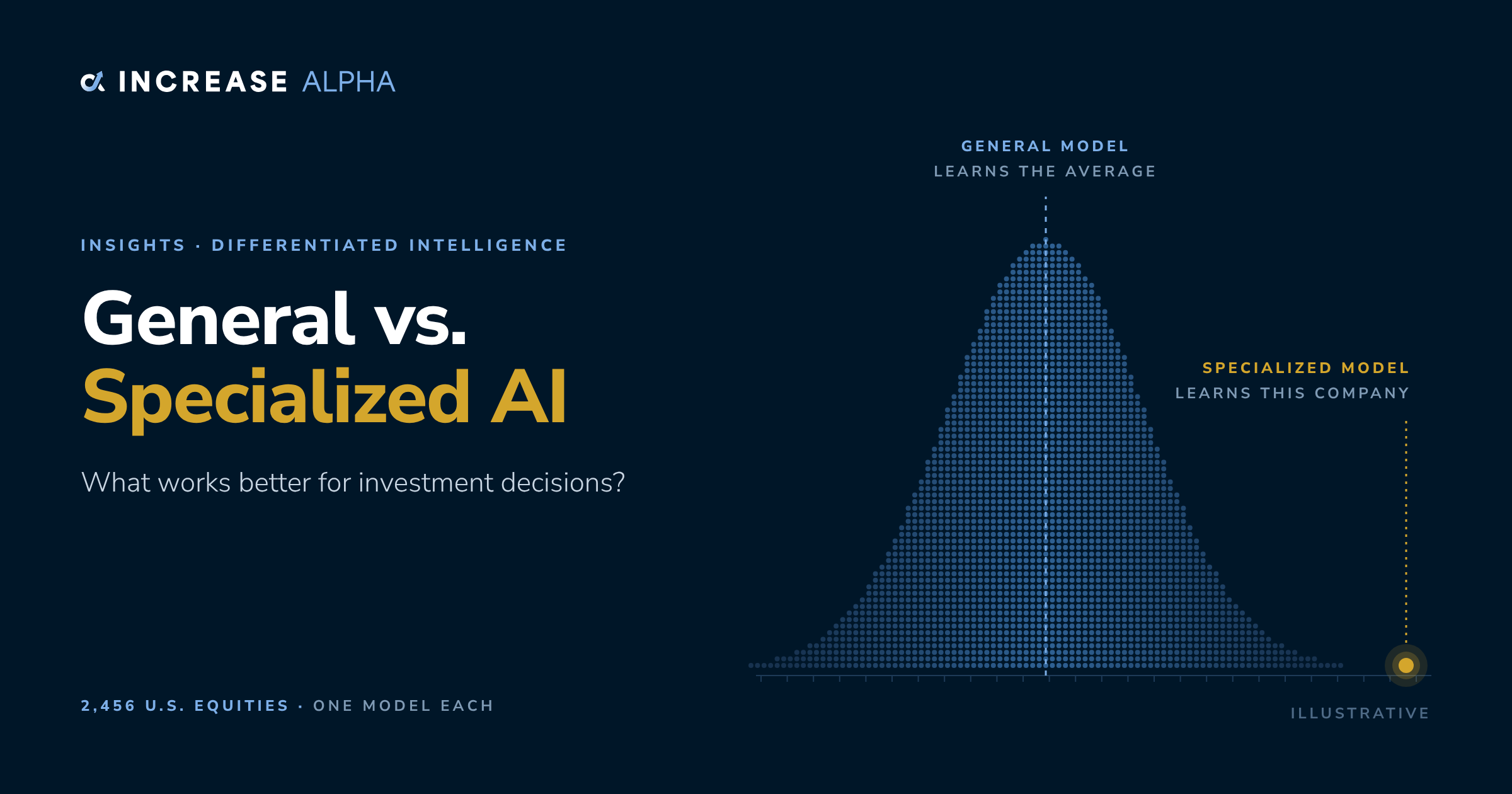
Most market models train across a broad universe, so they learn what a filing change means for the average company. Alpha sits in the tails, in the companies that depart from that average, and a model built on the average smooths those departures away.
Take a company whose 10-Q starts saying it “may” reach a target it used to say it “expects” to reach. For a biotech that has hedged every forward-looking statement for a decade, that is noise, but for an industrial that has guided with confidence for fifteen years, it is a reason to call management. A pooled model reads the same softening in both filings, while a model trained on that company’s history knows which one it is reading.
That is why we built each Increase Alpha model to function like it exists in a vacuum: it has never seen another company’s data and knows nothing we have not deliberately given it. The models are also deterministic, with no general-purpose LLM in the signal path, so the same inputs always produce the same output.
See it on a company you know
The best test is a name you already cover, where you can tell whether a finding is new. Send us a ticker for a sample News Gap Report, or request the signal specification and run the daily feed against your own factor model.
For institutional use only. Past performance is not indicative of future results.