What is the News Gap?
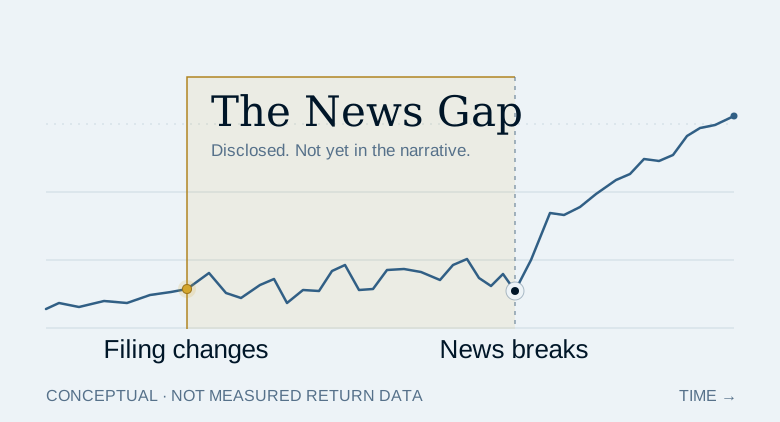
The News Gap is the time interval between a meaningful disclosure in an SEC filing and the market incorporating its implications into the stock price. Increase Alpha’s core premise is that this interval creates an opportunity for investors who recognize what changed and understand its implied impact before the wider narrative catches up.
The distinction between learning a fact and fully appreciating its consequences is older than electronic markets. In Edwin Lefèvre’s Reminiscences of a Stock Operator, the narrator describes waiting for Wall Street to absorb the financial consequences of the 1906 San Francisco earthquake. When a friend insists that the tape never lies, he answers: “It doesn’t always tell the truth on the instant.”
Today a headline reaches trading systems almost instantly, and high-frequency desks arbitrage the gap away within milliseconds. A changed sentence buried in a 10-Q behaves differently because someone still has to notice it, compare it against earlier disclosures, and work out what it means for the thesis. The clock starts the moment the filing goes public, but the alpha belongs to whoever understands the implications first.
The clock starts the moment the filing goes public, but the alpha belongs to whoever understands the implications first.
Why the News Gap persists
Not all material public information makes the headlines immediately, and data shows this gap comes up again and again across most public equities. If a filing is available to every investor at the same moment, why is there a gap at all? Because a consequential change in the language often goes unnoticed, especially when management does not draw attention to it or mention it on the earnings call. The challenge is catching all the changes, then identifying the ones that deserve a second look among pages of dense language.
We are not the only ones to notice this, and the academic literature backs it. In Lazy Prices, published in the Journal of Finance in 2020, Lauren Cohen, Christopher Malloy and Quoc Nguyen found that changes in corporate reporting language predicted subsequent returns and operating outcomes. They also found no immediate announcement effect, consistent with investors either missing those changes or failing to price their implications.
That is good reason to watch filing changes closely, though it stops short of proving any given change is material or not already priced in. The real questions for a research team are which changes matter now, whether they are bullish or bearish, and by how much. Standard due diligence rarely gets there, because earnings headlines, management commentary and valuation debates eclipse everything else, and a revised risk disclosure can remain unmentioned until the day it becomes news.
This pattern repeats every quarter across thousands of companies, and our own data shows the News Gap has not narrowed in recent years, which suggests the market still has no way to take advantage of it at scale.
From one changed sentence to a directional signal
Consider a company that adds a warning about its dependence on a single customer responsible for a large share of revenue. Revenue is still growing, the earnings release leads with demand, and the call runs on margins without anyone raising the concentration risk at all.
An analyst who catches the change can size that customer’s importance to the top line, put the new wording next to last quarter’s, and revisit the assumptions holding up the position. The outcome might be a revised thesis, a smaller position, or an informed decision that the risk is widely understood and already in the price.
Any of those options beats not knowing, and that is the case for filing intelligence: it points a research team’s attention at evidence that could change a decision while nobody else is looking there. Omissions work the same way, and they are harder to catch, because you only notice one if you knew what was there before. When a statement the market had already priced in disappears from a filing, say, an expected supply increase that never materialized, the absence is itself the signal.
Two strategies, two ways to use filing intelligence
Fundamental and systematic managers approach the same information with different intent due to a structural difference in how their portfolios are constructed.
A fundamental desk runs a small number of high-conviction positions, and its edge comes from knowing every name in the book better than the market. On an existing holding, a newly surfaced disclosure can either challenge their conviction or inform the next conversation with management. Outside the portfolio and the watchlist, that same disclosure can flag a name worth a first look. Filing intelligence changes where the analysts spend their hours: less time comparing claims across hundreds of filings, more time acting on the insights that the comparison turns up.
A systematic desk runs the opposite structure, a large number of low-conviction bets, where the only question is whether a filing-derived signal improves the existing model’s predictive power across a wide universe of names. This means back-testing the signal against the fund’s own factors, portfolio constraints, and implementation costs. A novel data source, even one with alpha potential, does not guarantee it will work in their book, and no quant expects one data source to carry a strategy by itself; it has to earn its place inside the existing system. The evidence has to show the signal contributes something beyond the data the portfolio already carries and has to be persistent enough to warrant its inclusion. Increase Alpha’s daily signal feed is designed to support that evaluation within an existing investment process.
How Increase Alpha generates the signal that drives alpha
Increase Alpha runs an independent model for each of the 2,456 U.S. equities it covers as of September 2026. Each model is trained on its own company’s history, with no shared parameters across tickers. That isolated design is deliberate and keeps each company’s own filings history at the center of the model, without introducing any market bias.
The forecasting system combines filing-derived insights with the company’s historical data to produce daily return predictions across ten trading-day horizons. It uses purpose-built, deterministic models rather than a general-purpose LLM in the forecasting process. The same inputs for the same company return the same signal every time, which is something most transformers struggle with.
The system has been live in production since July 2021, with predictions timestamped as they were made. That record gives a prospective client, especially investors running quantitative strategies, something concrete to analyze: how the signal behaved out of sample, and whether it would have added anything inside their own process. The Agent Explorer provides a starting point for reviewing company-level factor attribution and can be used by both fundamental and systematic investors. To dive deeper, request a signal spec here.
Why listening to calls and reading more filings is not enough
Any analyst can compare successive filings on a company they know well. But sustaining that discipline across a broad universe, while also covering earnings, maintaining models and managing a portfolio, is a heavy lift. Reading more documents will not produce better decisions, because your attention is the limiting resource, and it does not scale.
Increase Alpha’s fundamental research offering is built around that constraint. Filing themes are systematically checked against four information channels: the press release, the earnings call, financial news, and analyst coverage. Every finding traces back to the filing section it came from, so an analyst can inspect the evidence and decide what deserves more work. That removes the manual work of chasing a theme back through years of historical filings. Doing this by hand is barely possible across a dozen names and out of the question across hundreds. We do it on thousands, every filing season, as soon as they are published.
The signal comes from the gap between what the company disclosed and what the surrounding narrative is focused on. Alpha is generated by being early and trading within the News Gap.
Start with a name you know
The most useful test of filing intelligence is with a company you already cover, where you know the prevailing narrative, the last earnings discussion and the questions investors are asking. With that context you can judge whether a report has surfaced something consequential or merely something interesting.
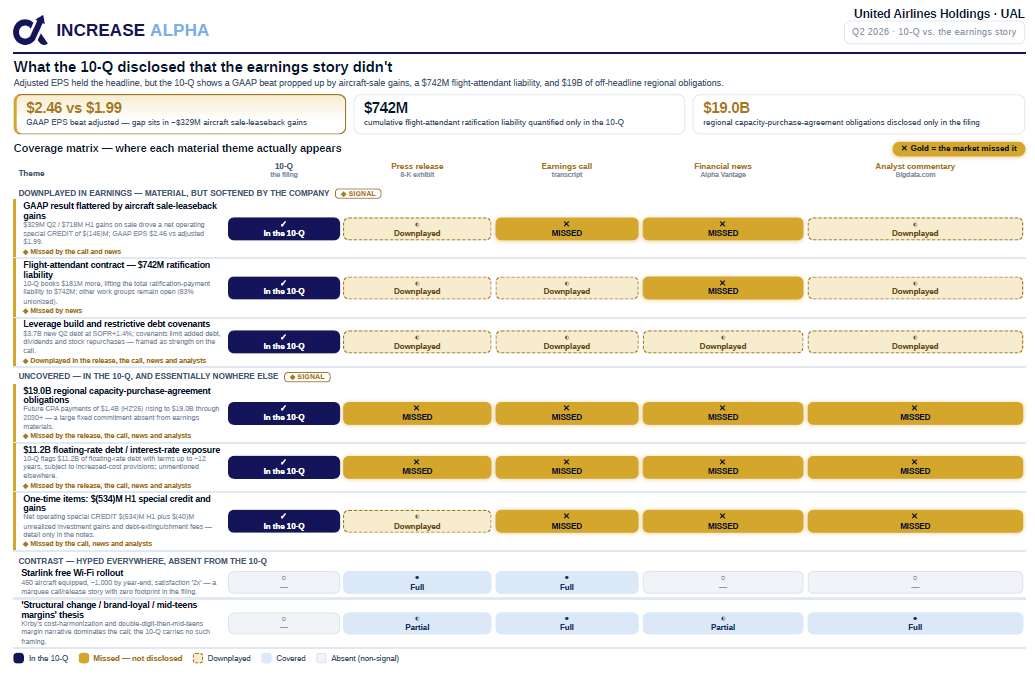
The News Gap opens the moment disclosure diverges from the market narrative and closes when the market finally catches up. How much alpha you capture in between comes down to your judgment of what the evidence means, what is already in the price, and how fast you act.
Send us a ticker you cover. We’ll provide a sample Filing Evidence Report so you can compare the findings with your own research.
For institutional use only. Past performance is not indicative of future results.